
Gita Pattison
- Smriti Jain
- 5 hours ago
- 8 min read

The story of Gita Pattison, who discovered that every stage can become a place of transformation.

The Stage Called, But the Heart Was Searching
In 1989, Gita Pattison began moving from the world behind the stage to the stage itself.
After seven years working in the music industry as a tour and promotion manager, she had already developed a deep understanding of the creative world. She knew the rhythm of performances, the dedication behind artists, and the many unseen details that bring music to an audience. Yet somewhere along the way, she realised she was not meant to remain only an observer.
She wanted to create.
Acting had always been a passion, but now it began to take a more central place in her life. When traditional acting schools considered her too old to begin formal training, Gita simply found another way. She studied with private teachers, continued developing her craft, and started building her own relationship with the stage.
A turning point came during her work promoting a musician who was also performing with the Shakespeare Company from London. Travelling with the company for ten days, she watched the same production of Hamlet several times. Rather than becoming tired of seeing the same performance repeatedly, she found herself captivated by the depth and power of the theatre unfolding in front of her.
It was one of those rare moments when an artist recognises something essential.
“This is exactly how theatre should be done.”
That experience changed the direction of her creative journey. Theatre was no longer simply an interest alongside her career; it became the path she wanted to follow.

By 1990, Gita had built a life that appeared, from the outside, to be full of success. Working as a freelance tour and promotion manager for a major record company, she found herself surrounded by some of the most celebrated names in music. Her career brought unforgettable encounters: sharing lunch with Joe Cocker, dining with Tina Turner, meeting Grace Jones, and spending memorable days in Nuremberg with Freddie Mercury.
It was an extraordinary world to be part of and yet, despite all the experiences, recognition, and opportunities that surrounded her, something inside remained unsettled.
Behind the excitement was a growing sense of emptiness. She found herself asking a question that would eventually transform the direction of her life:
How is it possible to have everything one could ask for and still feel that something is missing?
In December 1990, searching for clarity, Gita travelled to a quiet house in Denmark with the hope of focusing on her creative work and completing her first solo comedy programme. Away from the movement of her professional life, she was confronted with a deeper restlessness that achievements and experiences could not resolve.
That period became a moment of inner turning. She began to recognise that the answers she was seeking could not be found through external success alone.
When she returned to Hamburg, her life looked unchanged from the outside, but something within her had shifted. She began exploring different spiritual paths, reading, meeting teachers, and searching for something beyond ideas and second-hand knowledge.
She was no longer searching for another performance.
She was searching for truth.
A One-Way Ticket, Mashed Potatoes, and a Life-Changing Discovery
In 1991, Gita stepped away from the life she had carefully built.
From the outside, it looked like a dramatic decision. She left behind a successful career in the music industry, gave up financial security, sold much of what she owned, and bought a one-way ticket to Bangkok.
But for Gita, it was a heart longing search.
She had discovered that applause, interesting encounters, and a life surrounded by creativity could still leave an unanswered question quietly sitting in the background. Somewhere beyond the noise of the world, she was looking for something real.
For months, she travelled through Thailand, following that inner pull. She lived in a Buddhist monastery, practised Vipassana meditation, and experienced moments of peace. Yet somewhere inside, she knew she had not reached the end of the road.
Then came Kathmandu.
A city she had never visited before, yet one that somehow felt strangely familiar, as if an old memory had been waiting there. After travelling through the Himalayas, she returned to Kathmandu. And as life often does, the greatest turning points sometimes arrive disguised as ordinary moments.
In this case, it arrived in the form of a craving for German food.
Missing home, Gita walked into a small Austrian restaurant in Thamel. She was simply looking for comfort: mashed potatoes, sauerkraut, and smoked pork chops.
Instead, she found a brochure about Sahaja Yoga. On its cover was the photograph of Shri Mataji.
For a brief moment, a thought crossed her mind:
“She looks like me.”
Almost immediately, another thought followed:
“Nonsense, she doesn’t look like me at all.”
Years later, when she heard Shri Mataji explain that She had tried to make Her form resemble everyone else’s, that strange little moment suddenly felt like one more piece of a puzzle falling into place.
The owner of the restaurant, Lisa, began speaking with her about Sahaja Yoga, and the following day Gita attended her first class. The beginning was not without questions. She did not immediately experience what others described, and her analytical mind had plenty to say. But slowly, something began to shift. Through meditation, Shri Mataji’s talks, and Lisa’s endless enthusiasm for sharing everything she had learned, the pieces started connecting.
The search that had taken her through countries, philosophies, and countless questions finally began to find its answer. What she discovered was not an escape from life, but a deeper way of living it.
And with that discovery, her creativity found a new direction. Theatre, humour, and storytelling were no longer only expressions of talent; they became ways to share something deeper, to open hearts, and to create moments of connection.
The stage remained. But the purpose behind it had changed.
Building Stages Where There Were None
In 1995, Gita travelled to Nagpur to immerse herself in Indian classical music, discovering a new relationship between sound, expression, and the inner experience of meditation.
Music was no longer simply an artistic discipline. It became another doorway into awareness.
Soon after, she returned to Europe and became deeply involved in building the Theatre of Eternal Values, a project that brought together theatre, creativity, and the values of the Spirit. What began as an artistic experiment soon became a worldwide journey.
And Gita, true to her nature, did not simply participate. She helped build. She performed. She directed. She organised. She travelled.


The first TEV production, The Imaginary Invalid, took her across seven countries, where she played Toinette and helped bring this unique vision of theatre to audiences around the world. She later directed productions for the Vienna Boys’ Choir and continued developing theatre as a space where stories could do more than entertain; they could inspire reflection, connection, and transformation.


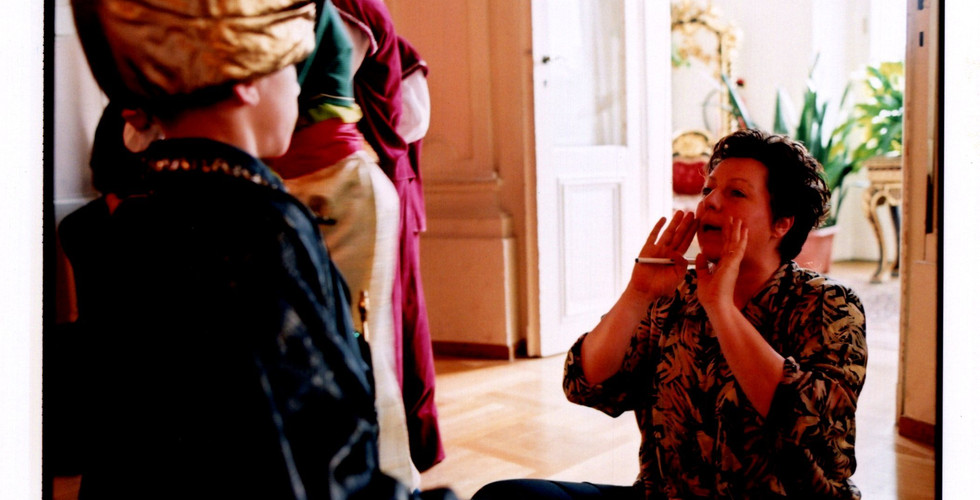
For Gita, building these spaces was never about waiting for the perfect moment or having every answer in place. It was about recognising when there was a need and stepping forward.
She often describes those early years with one simple principle: “Shri Mataji said, ‘Do it,’ and we did it.”
There was no endless calculation of whether everything would be easy, whether every resource was available, or whether the path was completely clear. There was trust, determination, and the willingness to step forward and allow the next step to reveal itself. That spirit carried her through countless rehearsals, new cities, unexpected challenges, and years of creative service.
Through theatre, music, talks, performances, and countless self-realization programmes, Gita travelled wherever there was an opportunity to share this experience with others. She stepped onto stages, into community halls, and into spaces where people were searching for something deeper, using the tools she knew best: storytelling, humour, emotion, and human connection.
Over the years, she became part of countless first encounters with meditation and inner discovery. Sometimes it began with a performance. Sometimes with a conversation. Sometimes simply with her ability to make someone feel welcomed, seen, and at ease. In those moments, creativity became more than expression. It became a bridge between hearts.
After moving to Canada, the stage continued to grow around her. She explored comedy, drama, musicals, improvisational theatre, and audio productions, while also spending nearly two decades sharing the art of improvisation with others. Through teaching improv at the Summer Arts Academy in Canajoharie, she passed on not only performance skills but also one of the greatest lessons of creativity: the courage to be present, to listen, and occasionally to fail beautifully.

Over the years, Gita’s creativity continued to find new forms. Theatre expanded into writing, educational videos, and projects that connected with seekers across different backgrounds.
The medium changed. The purpose remained.
Whether through a stage, a script, a workshop, or a camera, her work continued to carry the same intention: creating moments where people could open their hearts, discover something within themselves, and experience the joy of connection.
To create a moment where someone could pause.
To create a space where someone could connect.
To create an opening through which someone might discover something within themselves.
To create when there was no stage.
To gather people when there was no audience.
To continue serving when the path was uncertain.
Because for Gita, creativity was never only something she did. It became one of the ways she offered herself.
In recent years, her creative energy has found new expressions through writing, video, and digital storytelling. The theatre halls have expanded into new spaces where seekers from around the world can connect, learn, and explore.
Through her videos, writing, and educational work, she continues to share experiences gathered over decades of meditation, theatre, and collective growth. Alongside Julie Mandal, she co-authored Meditation Workbook: Step-by-Step Instructions to Build Your Daily Meditation Practice, a guide created to help seekers establish and deepen their meditation practice.
Her work today continues through:
I Meditate — a YouTube channel for intermediate seekers
Meditation Workbook — exploring practical steps for building a meditation practice
The Kölnerin — a lighter window into everyday life and humour in Canada
Alongside this, she is co-writing A Divine Vision for the Arts, a book documenting the beginnings of Theatre of Eternal Values, the inspirations, experiments, challenges, and unforgettable moments behind a movement that brought together creativity and spiritual expression.
True to Gita’s nature, even the completion of a book becomes its own adventure, requiring patience, persistence, and perhaps a little negotiation between divine timing and human editing schedules.
When asked about the most memorable moments of her artistic journey, Gita’s answer is simple:
“Oh boy ! I actually just wrote a whole book about that with another TEV member.”
And perhaps that says everything.
The story has been too full to fit into one memory.
Too many stages. Too many journeys.
Too many people met along the way.
Too many moments where a song, a performance, a conversation, or a simple laugh became a doorway to something deeper.
The curtains have opened in different places. The stories have taken different forms. But the purpose behind them has remained the same: to create moments where hearts can open and people can discover something deeper within themselves.
From the young woman searching for answers beyond the spotlight, to the artist who spent decades creating spaces for others to discover their own inner light, Gita’s journey has always been about transformation.
A Note to Young Artists in her own words
“Determination is essential. You need a strong desire to please the Goddess, no matter what. When we started programmes in new cities or began building Theatre of Eternal Values, we did not spend all our time asking, ‘How will this work? How will we find the space? How will everything be managed?’ We simply stepped forward.
Shri Mataji said, ‘Do it,’ and we did it. There were challenges, of course, but there was also a deep trust that if the intention was sincere, things would somehow come together. Life was not always easy, but it was always supported in ways we could never have planned.”

Comments